
CINCINNATI, OH — For thirty years, Sarah Hendricks did everything her dentist told her to do. She brushed twice a day. She flossed every night. She used the strongest antiseptic mouthwash she could find on the shelf — the kind that burned so badly it made her eyes water.
None of it stopped the bleeding.
Every six months, she sat in the same dental chair and heard the same diagnosis: "early gum disease." Every six months, she handed over another check for $300. And every six months, she drove home wondering how long she had before she ended up like her mother — who lost most of her teeth in her early sixties.
"I was the woman who smiled with her hand over her mouth," Sarah told Vazence Health, speaking from her kitchen on a Tuesday afternoon. "At my granddaughter's fifth birthday party, I sat behind the cake so I wouldn't be in any of the photos."
"After three decades of doing everything right — and watching my mother lose her teeth — I was ready to accept the same fate."
The Discovery That Changed Everything
Sarah's turning point came not from her dentist, but from a brief conversation between her daughter and her dental hygienist.
The hygienist mentioned, in passing, an emerging field of research focused on the oral microbiome — the community of bacteria that lives in the human mouth. A study published in Springer Nature in May 2022 had found something surprising: people with healthy teeth and gums consistently had a high population of beneficial bacteria in their mouths.
The implications were unsettling. For fifty years, the entire oral care industry had been built around one idea: kill the bacteria. Mouthwashes promised to eliminate "99% of germs." Antiseptics promised "12-hour protection." But the new research suggested that this approach — which scientists began calling over-sterilization — was killing the beneficial bacteria along with the harmful ones, leaving people's mouths in a state of imbalance that often grew worse over time.
"It was the opposite of what I'd been doing for thirty years," Sarah said. "And the more I read, the more it explained why nothing I tried ever worked."
The 60-Second Protocol
The hygienist had mentioned a specific product — a doctor-formulated chewable tablet developed in the United States, designed to repopulate the oral microbiome with three clinically-studied probiotic strains. The brand was called ProDentim.
The protocol was, Sarah said, almost insultingly simple.
One chewable tablet. Taken in the morning. Dissolved slowly in the mouth.
That was it. No replacement of her existing routine. No giving up brushing or flossing. Just one additional sixty-second step at the start of her day.
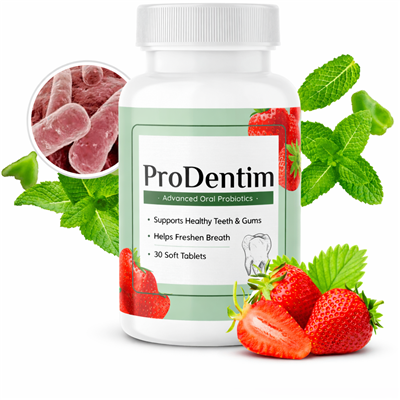
Each tablet, according to the manufacturer's documentation, delivers 3.5 billion CFU across three probiotic strains: Lactobacillus paracasei (studied for its ability to inhibit the bacteria most associated with plaque), B. lactis BL-04 (linked to immune and respiratory support), and Lactobacillus reuteri (which produces compounds shown to reduce gum inflammation). Four supporting natural ingredients — including inulin, tricalcium phosphate, malic acid, and peppermint — round out the formula.
Sarah ordered a single bottle. She wasn't, she admits, expecting much.
Eleven Days In
On the morning of day twelve, Sarah flossed without bleeding for the first time in seventeen years.
"I just stood at the sink and looked at the floss," she said. "I rinsed it under the tap and there was nothing. Clean. I genuinely thought I'd done something wrong."
She kept going. By day thirty, the chronic gum sensitivity that had made iced drinks unbearable for years had faded. By day sixty, the morning breath that had embarrassed her in front of her husband for two decades was gone. By day ninety, her granddaughter — the one whose birthday party she had hidden behind the cake at — paid her the compliment that Sarah now repeats to anyone who will listen.
"Grandma, you look so pretty when you smile."
"I cried in the bathroom for an hour," Sarah said. "I'm not proud of that. But that's what happened."
"In twenty-two years of practice, I've never seen a reversal like this in a patient. Whatever she's doing, she should keep doing it."
Why You Haven't Heard About This
If ProDentim's protocol is as effective as Sarah's experience — and as the manufacturer's customer database of over 12,000 verified buyers — suggests, a reasonable question follows: why isn't this in every drugstore?
The answer, according to the manufacturer, is intentional. The product is sold exclusively through its official website — not Amazon, not pharmacies, not big-box stores. The reasoning is quality control: probiotic strains are sensitive to manufacturing variation, and the company has chosen to keep distribution tightly held rather than license to third parties where formula consistency cannot be guaranteed.
There is also the question of price. A single bottle retails at $69. A three-month supply — the minimum the manufacturer recommends for the probiotic colonies to fully establish — runs $177. The full six-month protocol that Sarah followed costs $294, or roughly $1.63 per day.
"It's not nothing," Sarah acknowledged. "But neither was the $300 my dentist was charging me every six months."
According to the manufacturer's representative we contacted for this story, the discounted multi-bottle pricing has changed twice in the past six months as supply has tightened. Today's pricing structure includes free U.S. shipping on the three and six-bottle bundles, along with two complimentary bonus guides ("Hollywood White Teeth at Home" and "Bad Breath Gone — One Day Detox"). The company representative was unable to guarantee how long the current pricing would remain available. Readers interested in the protocol Sarah followed can view today's pricing on the official ProDentim site.
What Other Readers Are Saying
Since Vazence Health first reported on ProDentim earlier this year, we've received hundreds of reader emails. The pattern in them is striking. Most fall into one of three categories: women in their fifties and sixties dealing with bleeding gums and the financial drain of repeated dental visits; men in client-facing professions whose self-consciousness about breath was affecting their work; and adult children who'd watched a parent lose their teeth and were quietly terrified of going the same way.
"I work in sales," wrote one reader, Michael H., 47, of Austin, Texas. "The breath thing was killing my confidence in client meetings. Six weeks in, I'm in face-to-face pitches without thinking about it once. I closed two deals last month I would've talked myself out of."
Another reader, Rosa M., 51, of Phoenix, Arizona: "My dentist asked what I was doing. He's never asked me that before. Every six months it was 'we need a deep cleaning.' Last visit, nothing. I just smiled."
"Whatever you're doing, keep doing it."
The Bottom Line
ProDentim is not a cure. The manufacturer is careful to point this out, and so are we. Individual results vary. The product has not been evaluated by the FDA for the treatment of any specific condition. People with acute dental problems — abscesses, severe pain, advanced periodontal disease — need professional care, not a supplement.
But for the millions of adults like Sarah Hendricks, who have spent decades doing everything they were told to do and watching their gums bleed anyway, the emerging science of oral probiotics may represent something most of them have stopped expecting: a different answer.
The protocol Sarah followed is available on the manufacturer's official site, where current pricing, ingredient breakdown, and the 60-day money-back guarantee are listed. As of publication, the company was still offering free U.S. shipping on multi-bottle orders.
"If you'd told me a year ago that one chewable tablet a day would do what twenty thousand dollars in dental work couldn't," Sarah said, "I would have laughed at you."
"I'm not laughing anymore."